Purdue University x Hendricks Commercial Properties | CGT 40700 (Current & Future Trends in Themed Entertainment)
Semester Final Project | Traction Yards / Circle Centre Mall Redevelopment Concept
Experience Strategy & Placemaking for a Downtown Indianapolis Redevelopment
Traction Yards is Hendricks Commercial Properties’ redevelopment of the former Circle Centre Mall in downtown Indianapolis. As part of Purdue University’s Themed Entertainment Design program, our team explored how experiential strategy and placemaking could help transform the site from a conventional retail destination into a mixed-use district people would choose to visit, linger in, and return to.
The project sits at the intersection of several audiences and uses: local residents, convention visitors, office workers, hotel guests, retail, dining, entertainment, and public space. The challenge was not simply identifying what could occupy the site, but creating enough reasons for the district itself to become a destination.
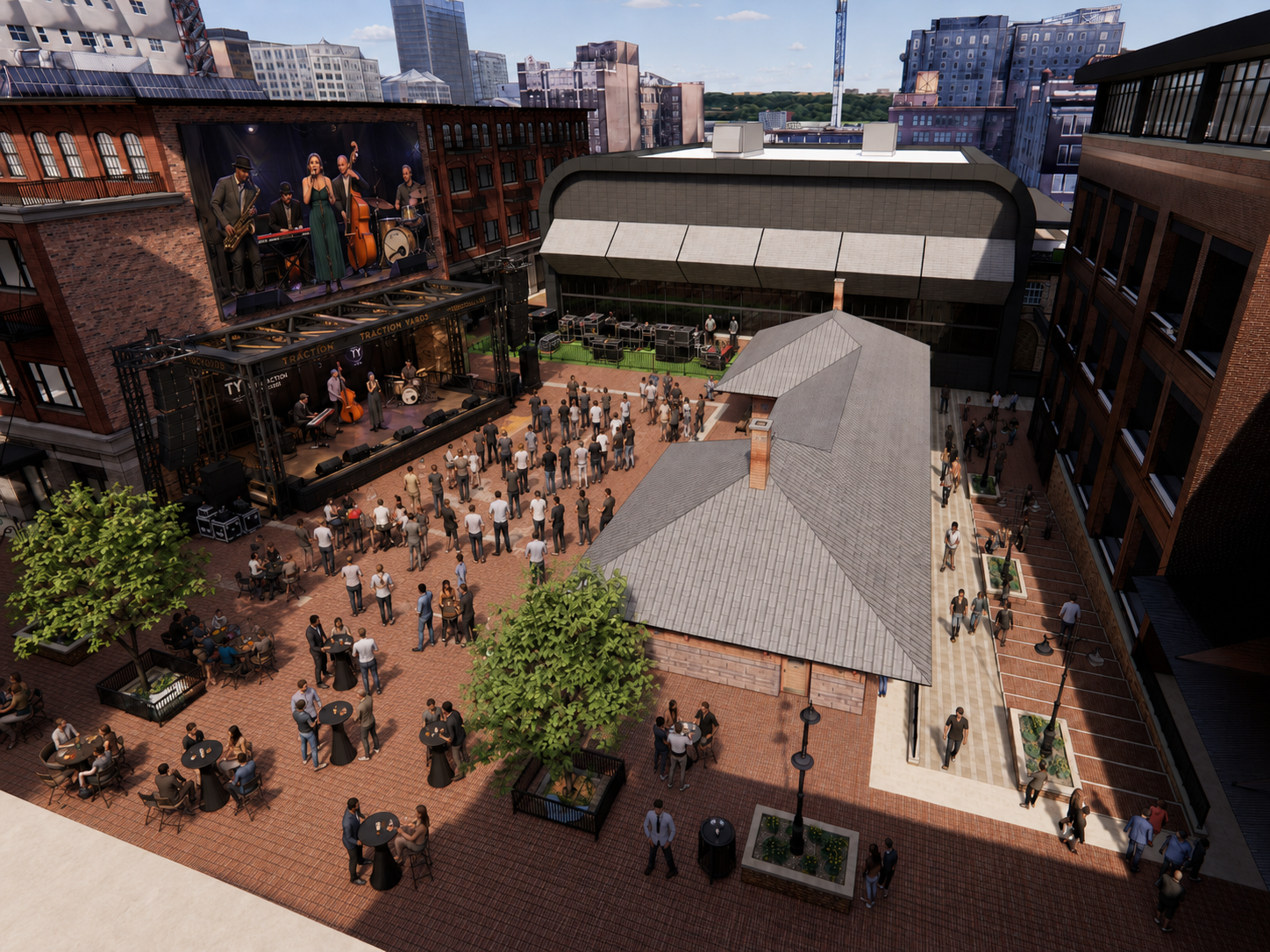
Selected concept rendering from the final presentation.
Project Snapshot:
Client / Stakeholders: Hendricks Commercial Properties
Context: Early-stage strategy and placemaking
Timeline: Multi-week team project culminating in a client presentation
Deliverable: Experience strategy, programming concepts, feasibility considerations, and final presentation materials
My Role: Strategy framing, audience / experience thinking, adaptive-reuse research, preliminary cost considerations, presentation development
Project Details:
Project Type: Mixed-use redevelopment / urban placemaking
Site: Former Circle Centre Mall, downtown Indianapolis
Focus: Audience strategy, destination anchors, programming, local identity, adaptive reuse, and practical feasibility
Outcome: Final concept presented to Hendricks Commercial Properties leadership; several elements, including the streetcar-history framing and audience framework, received positive client feedback
Artifacts:
Final presentation (as presented)
Experience Strategy:
We organized the concept around five experience pillars:
Gathering: Spaces that encourage people to meet, linger, and spend time together
Food & Social Life: Local restaurants, bars, markets, patios, and other uses that create everyday reasons to visit
Entertainment: Anchor experiences and flexible programming capable of generating destination trips
Local Culture: Indianapolis history, businesses, makers, and events that give the development a sense of place
Urban Connectivity: A district that connects naturally with downtown hotels, offices, conventions, sporting events, and pedestrian activity
The strategy considered three primary audiences: locals seeking stronger reasons to come downtown, visitors looking for an authentic Indianapolis experience, and daily users such as residents, employees, and hotel guests.
From Concept to Practicality
The project also required us to test the concept against practical development considerations. Our work incorporated:
Adaptive-reuse precedents and indicative cost benchmarks
Base-building versus tenant improvement responsibilities
Operating and revenue implications
Event, lighting, AV, and projection infrastructure
Programming and activation concepts
Feasibility considerations within the existing physical site
The intent was not to produce a definitive development plan. Instead, the exercise explored how experience-led thinking could work within the constraints of a real mixed-use redevelopment.
My Role:
My contribution focused primarily on the strategic and commercial side of the project:
Framing the development around reasons to come, stay, and return
Developing the destination-anchor / memory-anchor framework
Contributing to audience segmentation and experience strategy
Evaluating programming, activation, and dwell-time Implications
Researching adaptive-reuse economics and comparable projects
Supporting event / AV infrastructure and feasibility thinking
Using History as a Design Language
The Traction Yards name draws from Indianapolis’ historic interurban rail network and the former Traction Terminal nearby. Our focus was on using the history as design language vs. creating a literal transportation museum. As a result, our approach incorporated concepts such as rail-inspired paving, industrial materials, signage, lighting, public art, and movement cues could create a recognizable identity without turning the district into a recreation of the past.
Further, our strategy emphasized the distinction between destination anchors and memory anchors – the former being used to give someone a reason to visit in the first place, while the latter creates a reason to return. Rather than viewing the development only as retail infrastructure, we began thinking about it as memory infrastructure (a place designed to accumulate rituals, traditions, and personal associations over time.
That approach resonated with Hendricks, whose leadership specifically noted that the streetcar-history angle introduced a perspective they had not previously explored.