Purdue University | CGT 20400 (Introduction to Themed Entertainment)
Semester Group Project
Themed Land Concept | The Lost Valley of Ancients
Collaborative themed-land concept developed as a full-stack design exercise spanning narrative premise, attraction planning, guest flow, spatial organization, and preliminary commercial feasibility. Created as a semester team project, the work translated an original adventure IP into a cohesive land-level experience with defined anchors, supporting offerings, and a clear visitor journey.
I contributed to concept development, attraction planning, layout thinking, presentation narrative, and the business-case framing that helped connect the creative vision to operational plausibility.
Curated Excepts from the final team presentation. Full deck available below.
A Land-Scale Design Exercise Built to Real Standards
The Lost Valley of Ancients is an original adventure-archaeology concept for a ~12-acre themed land set within a fictional theme park destination in the Houston metropolitan area. The project was a full-stack design exercise spanning original IP development, narrative and faction architecture, guest journey sequencing, land layout, F&B and retail programming, and a capital budget built from the ground up using industry methodology.
My role in practice was primary driver across most of the project's structural and conceptual layers – narrative framework, IP development, guest journey, attraction scripting, presentation deck architecture, budget modeling, and feasibility framing. My teammates contributed via narrative collaboration, SketchUp land schematics, restaurant menu mockups, and additional concept assets in the final presentation.
The Concept
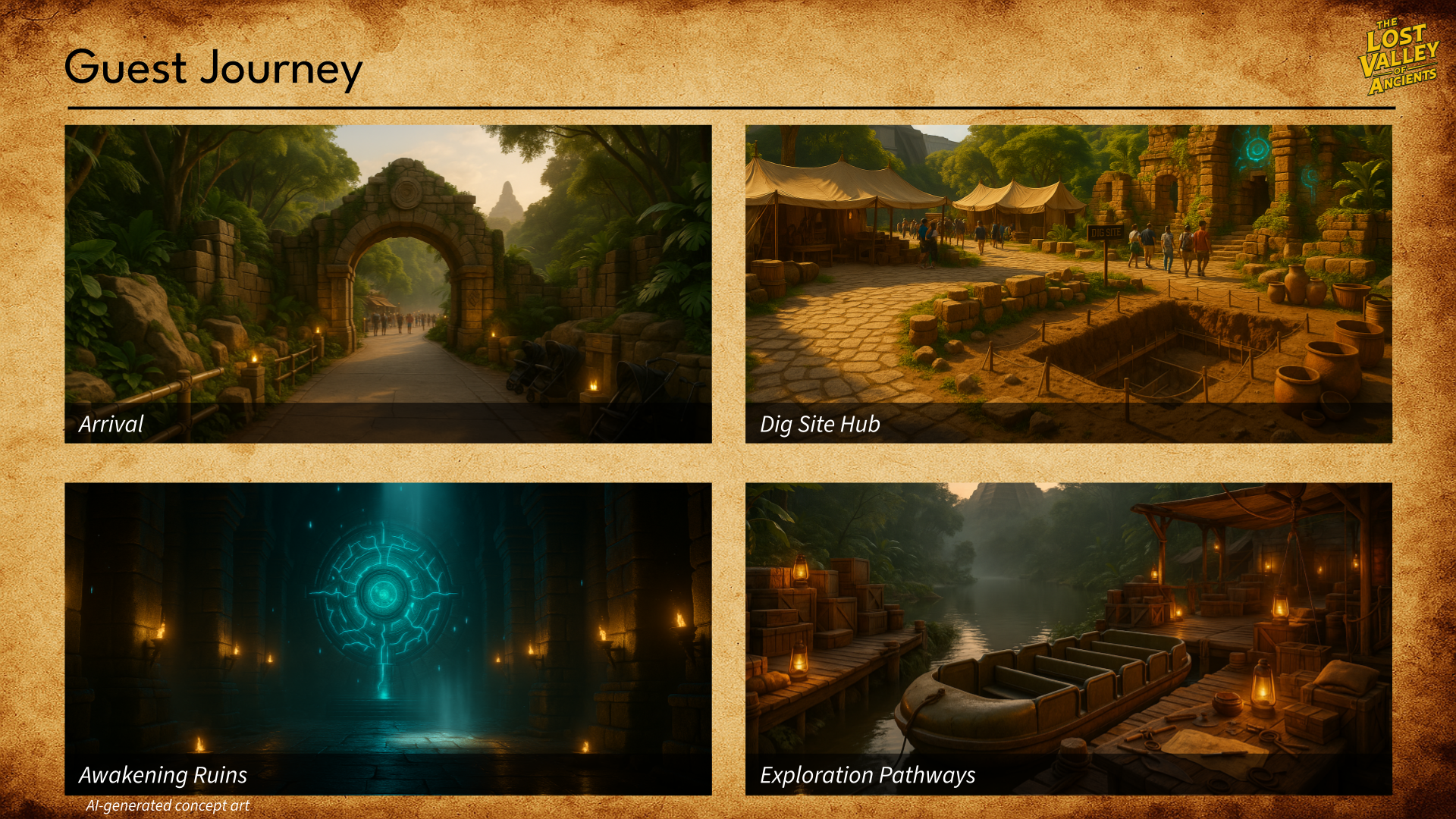
The land is built around an original fictional civilization – the Aurotec – whose jungle ruins have been rediscovered by three competing expedition factions: the Horizon Guild (scholars), the Aurelia Company (relic hunters), and the League of Grand Explorers (showmen). Guests arrive as new recruits to the Horizon Guild's encampment and move through the land as the three factions pursue conflicting agendas across dig sites, waterways, and the temple complex itself.
The three-faction structure was a deliberate worldbuilding choice: it creates built-in narrative tension without a clear villain, gives guests a range of tones to engage with (earnest, slapstick, and theatrical), and gives the land natural anchor points for F&B, retail, and live entertainment – each venue tied to a specific faction's identity rather than floating free of the story.
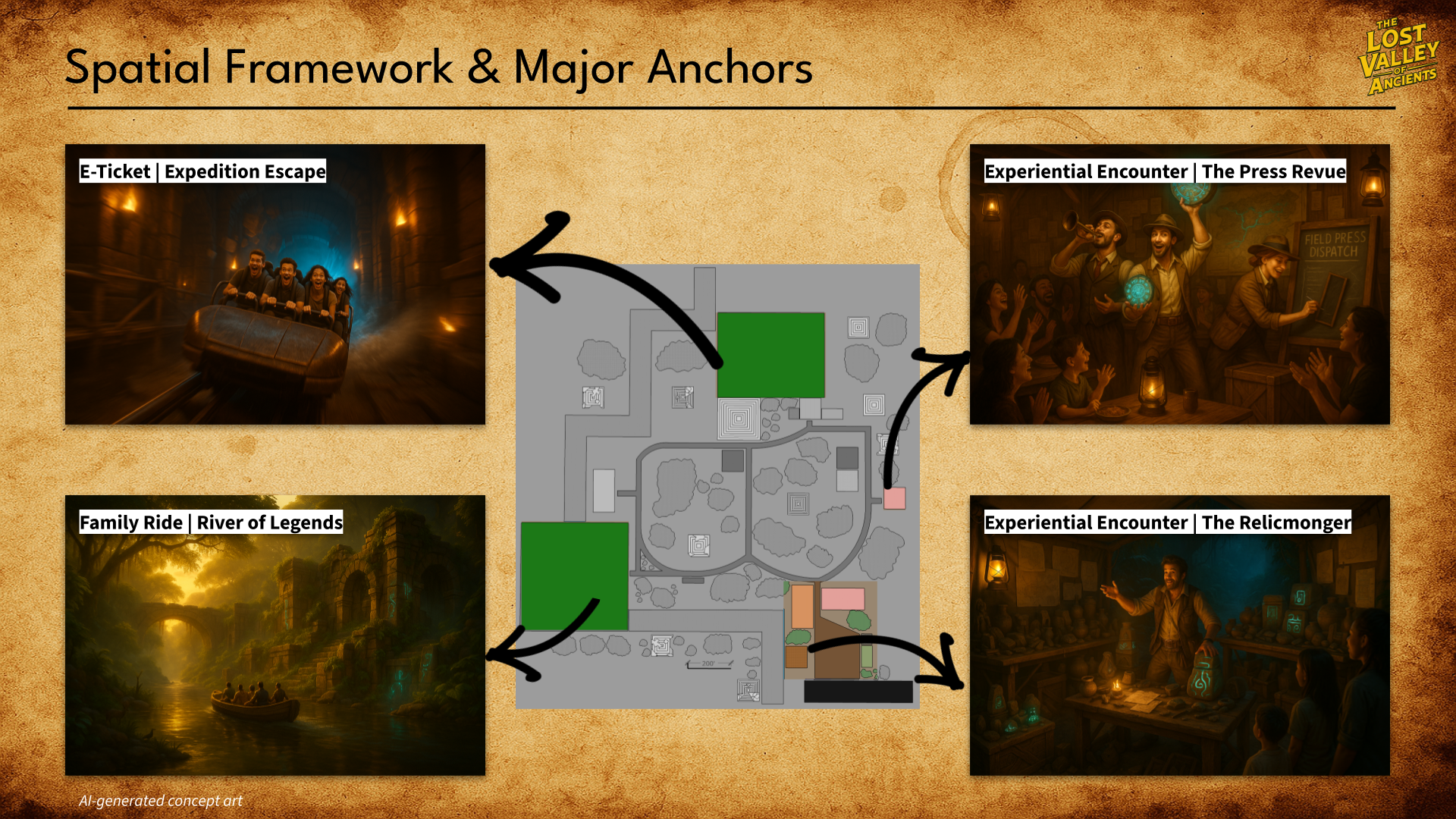
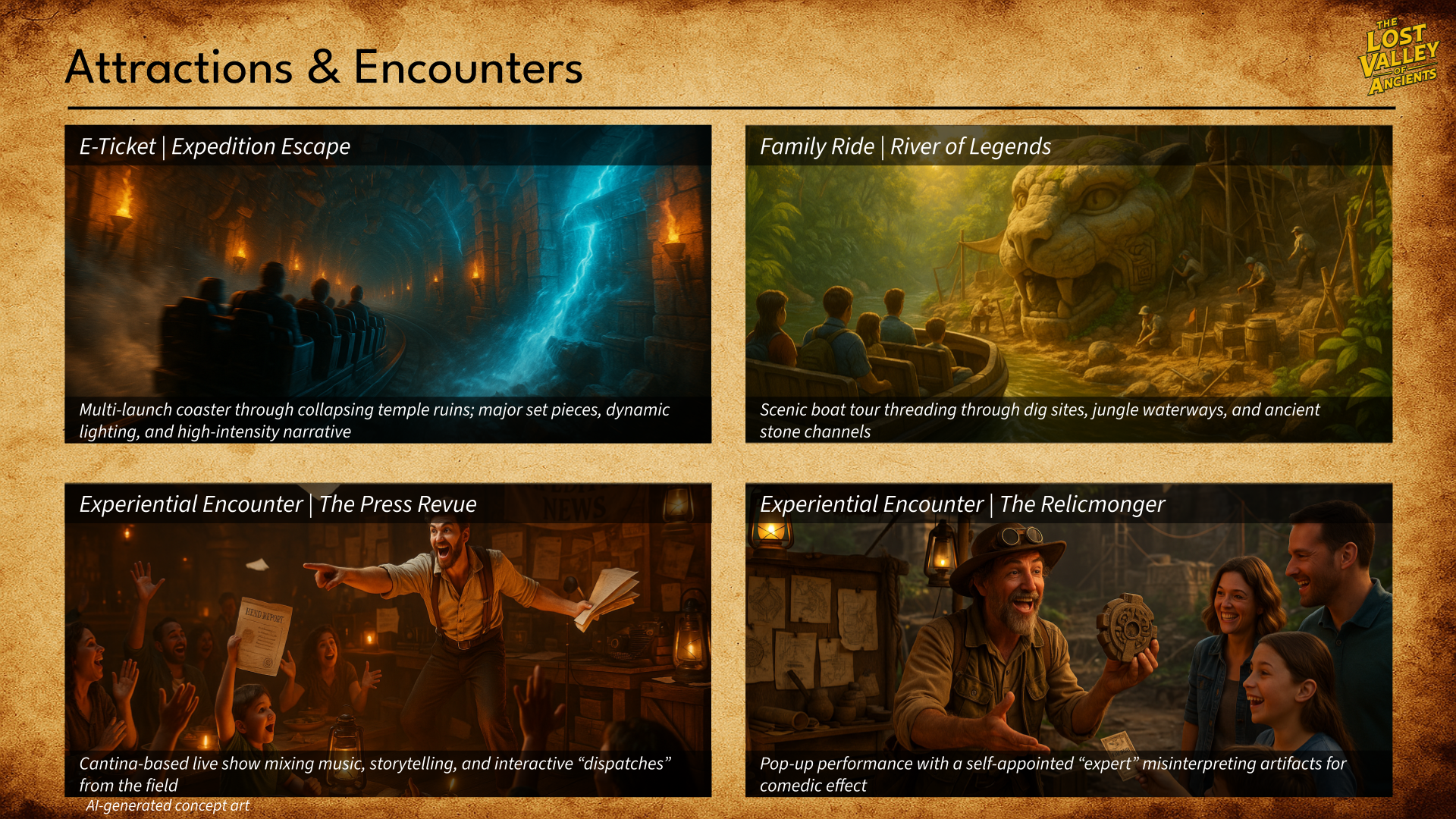
The attraction mix pairs a multi-launch E-ticket coaster (Expedition Escape: Temple of the Aurotec) with a scenic family boat ride (River of Legends), supported by two experiential character encounters. The E-ticket sends guests through a destabilizing temple as its internal mechanisms reawaken – collapsing scaffolds, flooding passages, and projection-assisted show scenes before a final launch escape. The family ride follows expedition skiffs along the valley's ancient river, threading through dig-site outposts and overgrown stone channels at a pace that builds world rather than intensity.
Where I Focused
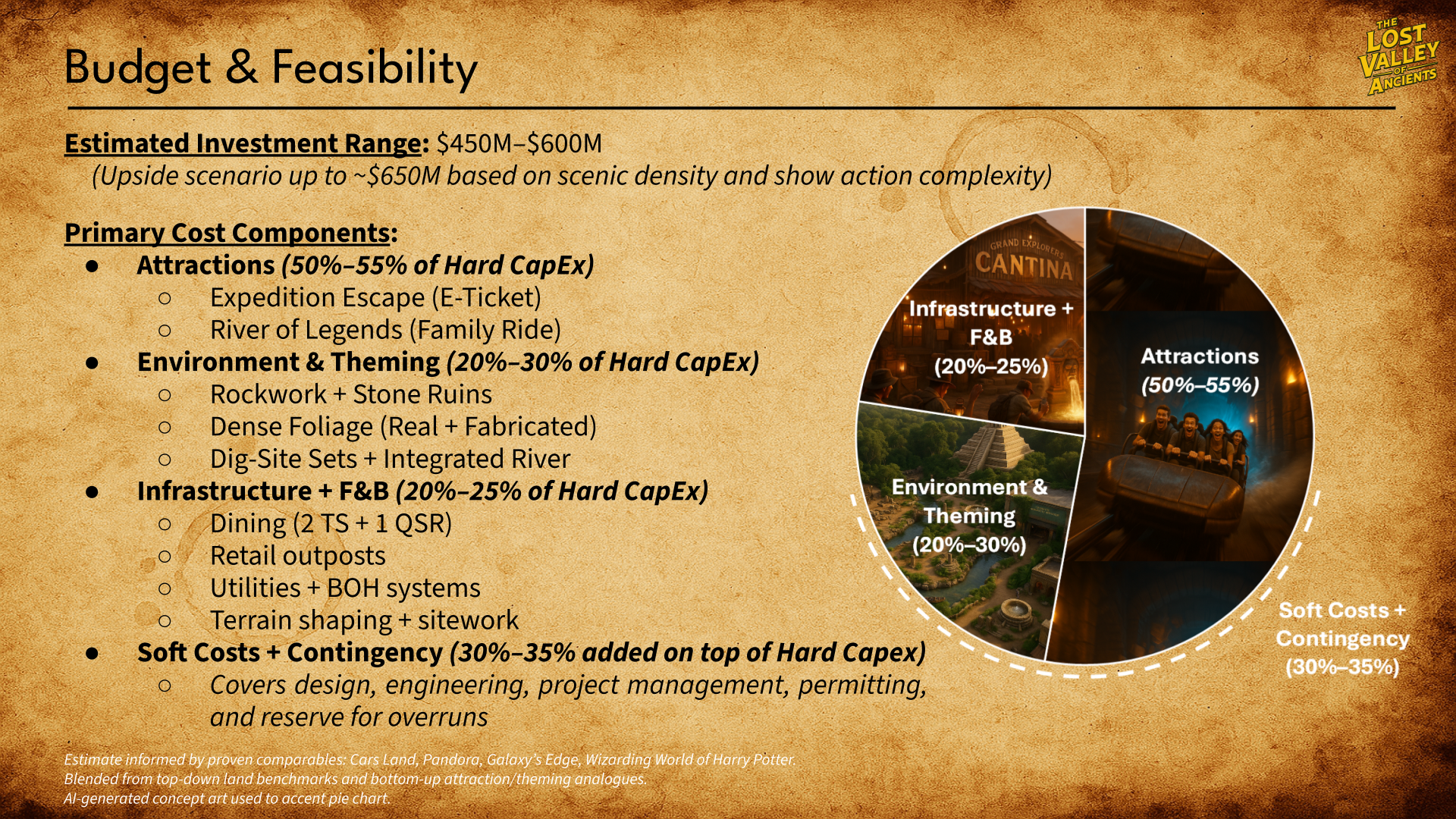
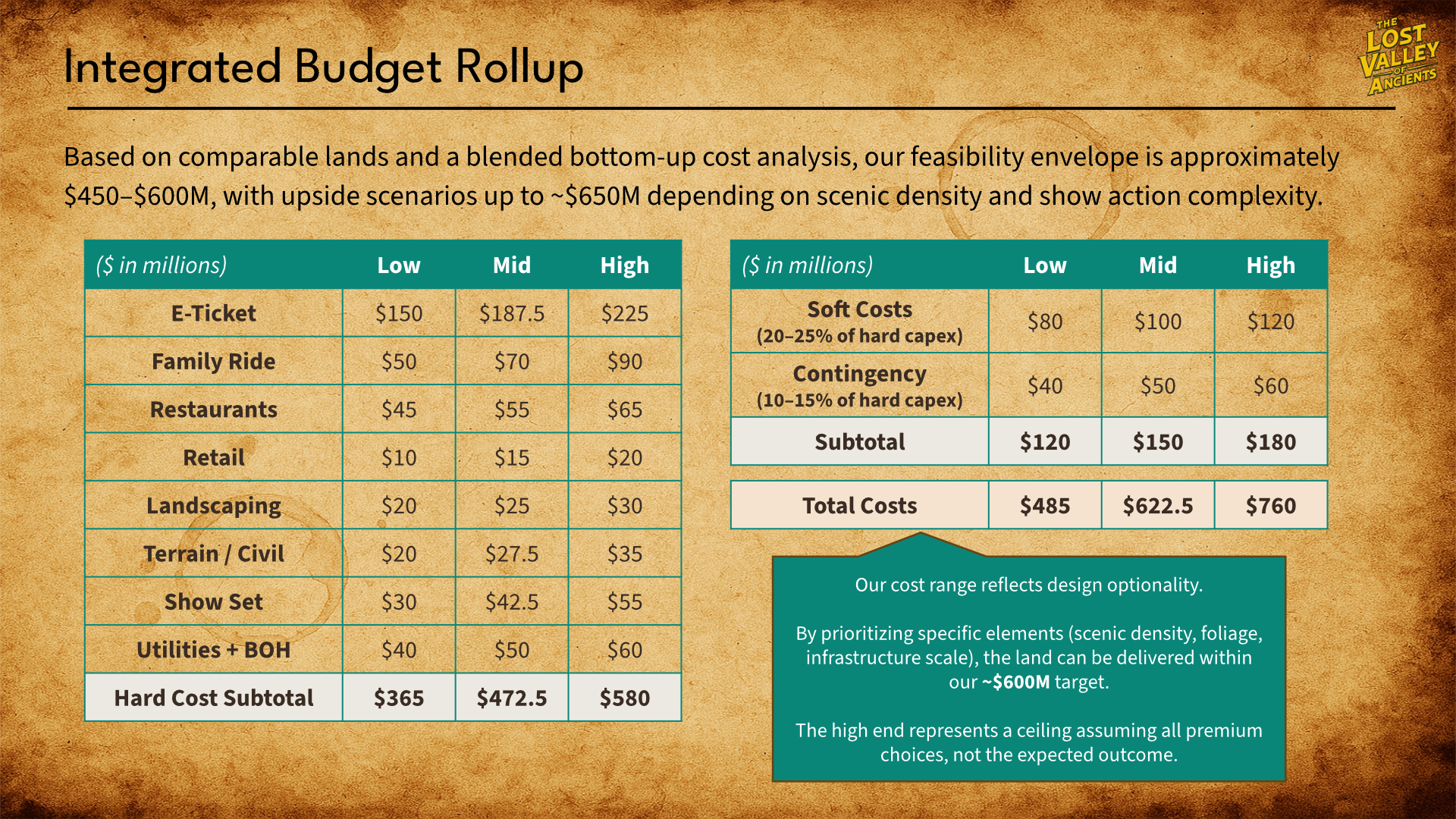
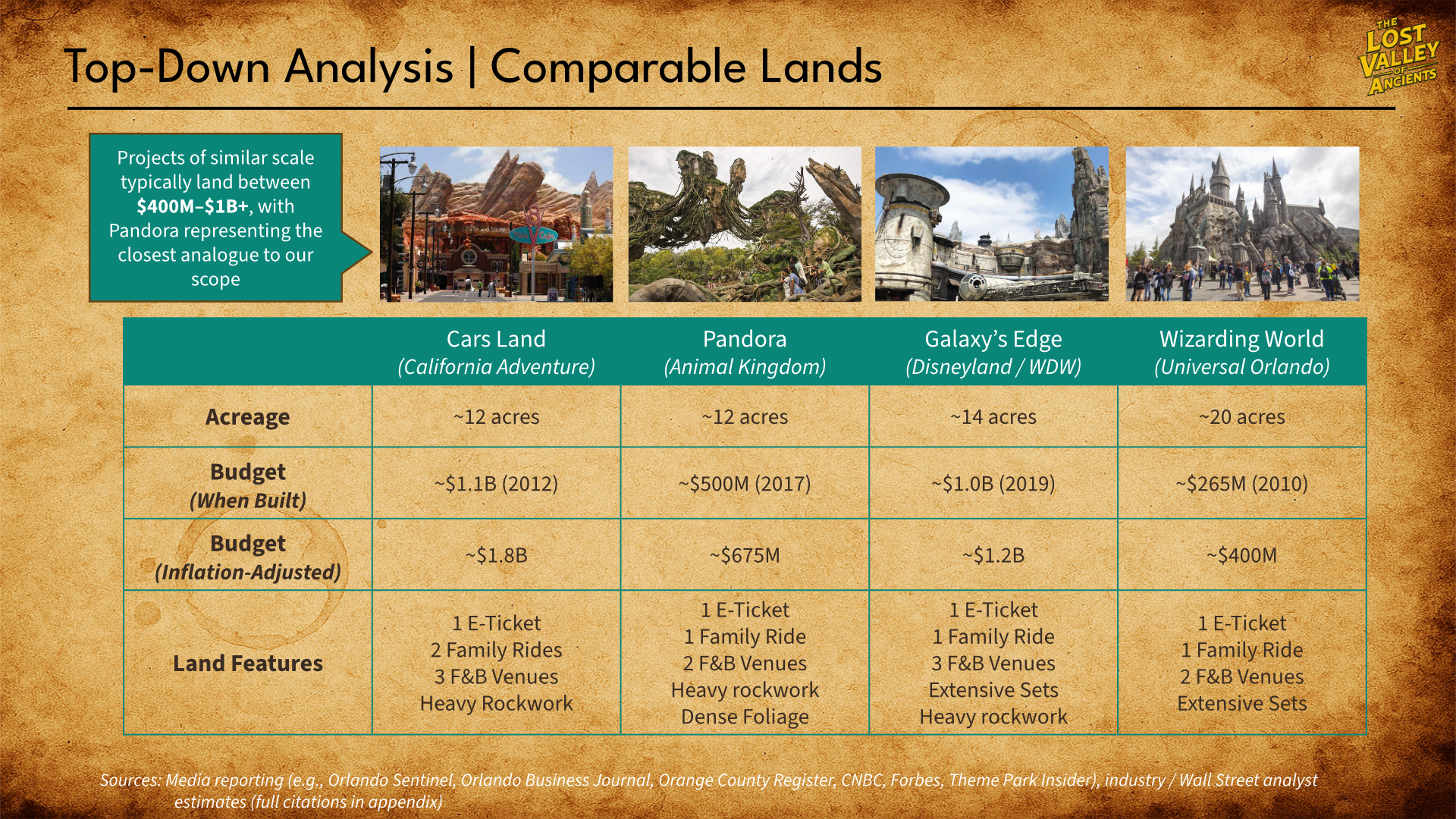
The budget and feasibility section was where my background came through most directly. I built a capital estimate using dual methodology: top-down land benchmarking against Pandora, Cars Land, Galaxy's Edge, and Wizarding World (inflation-adjusted), and a bottoms-up component build covering E-ticket, family ride, F&B buildouts, scenic theming, terrain, utilities, and soft costs. The resulting feasibility envelope landed at $450–$600M, with micro-comp tables for each attraction type and a clear explanation of what drives the range. The budget section was a differentiated add – noted in feedback as one of the most thorough treatments the instructors had seen in six years of teaching the course.
My background also shaped the deck sequence – narrative and factions first, then look and feel, spatial layout, and attraction detail, before moving into market sizing, revenue model, and capital structure (years of reading CIMs apparently left a mark).
What the Project Covered
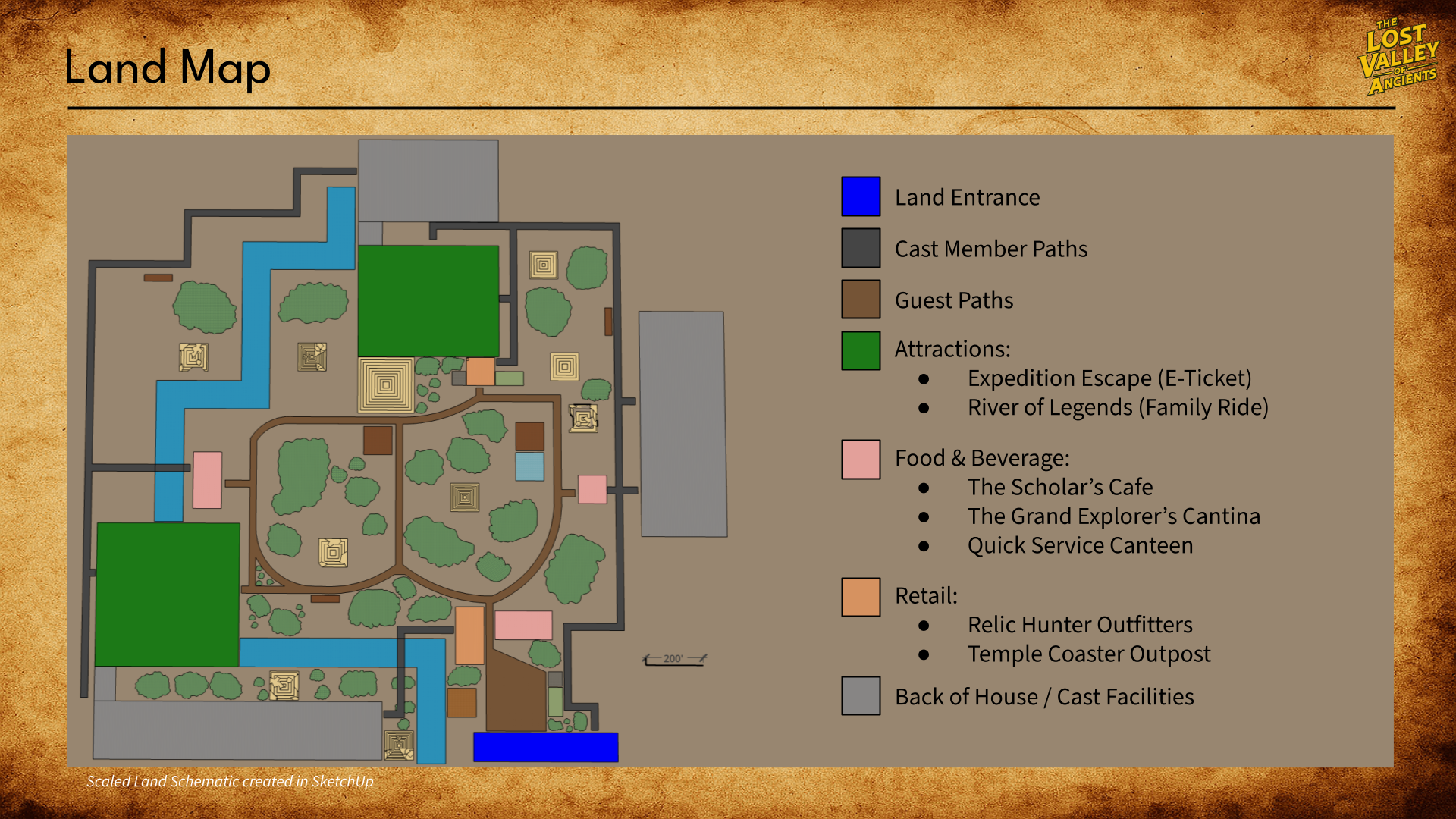
At full scope, the final presentation spanned: original IP and lore development; three-faction narrative architecture; guest journey and engagement depth (Waders / Swimmers / Divers framework); land layout with scaled SketchUp schematics including guest and backstage circulation; attraction and show development for four experiences; look-and-feel, color palette, graphics language, and signage concepting; cast costume design; sound and scent design by land zone; F&B programming with themed menus for three venues; retail programming with faction merchandise and add-on experience concepts; market sizing for the Houston metro; revenue model and per-cap spending logic; and a full capital budget with comparable land benchmarking.